
Spoke to Mr Stewart on Friday about my essay, and made some appropriate changes.
1. I re-did my introduction.
2. Got the word count down to 1999 - TOOK FOREVER!!!!!
3. re-ordered my endnotes and appendices and bibliography
4. read over my essay about 559230537250270525703275 times
5. danced around the room because i am finnaly DONE!!
FINISHED COMPLETED CONCLUDED DONE AND DUSTED THE END FULL STOP NEVER HAVE TO DO IT AGAIN WHOOOOOOO!!!!!!!!!!!!!!!!!!!!!!!!!
Sunday, September 5, 2010




Saturday, September 4, 2010
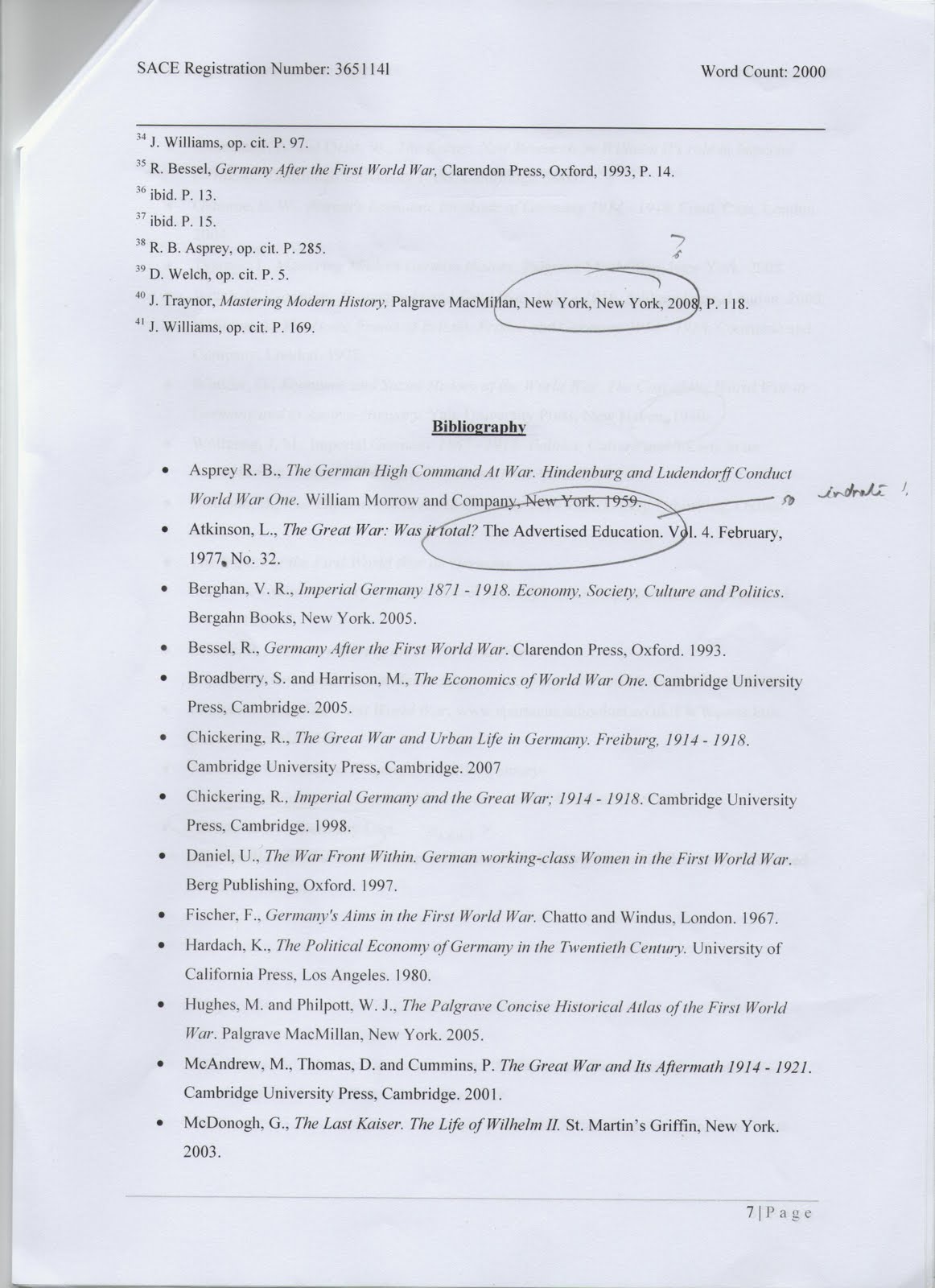
Drafting - Page 1
please note; my computer is slow and this taking me hours to upload *groan*
Ok .... yes well I can't upload any more drafting for some reasons so I"ll try it at school..... TECHNICAL DIFFICULTIES!!!!!!!!!!!!

Wednesday, September 1, 2010
HAVING A STRESS OUT!!!
So having a stress out because I got an email saying that we couldn't consult with Mr Stewart next week so yes - trying very hard to make my essay perfect by TOMORROW!!!!!!!!!!!!!!
Monday, August 2, 2010
Log Entry ~ Appendices
I have entered in 2 appendices.
1 table on Deaths among the German civilian Population 1914 – 1919.
the other a map showing the British Naval Blockade of Germany.
I have referred to each of these once throughout the essay.
1 table on Deaths among the German civilian Population 1914 – 1919.
the other a map showing the British Naval Blockade of Germany.
I have referred to each of these once throughout the essay.
Wednesday, July 28, 2010
I AM
FINISHED!!!!!!!!!!!!!!!!!!!!!!!!!
just need to polish now
I'm about 20 words over the word count, so I'll work on cutting that back, but otherwiswe
whooohoooo!!!!!!
just need to polish now
I'm about 20 words over the word count, so I'll work on cutting that back, but otherwiswe
whooohoooo!!!!!!
Tuesday, July 27, 2010
This Week I........
- Went to the Barr Smith
- Added the new books I got to my bibliography page
- Did more work on the independent essay
- stressed out
Wednesday, July 21, 2010
Log of Thursday 22 July
Mr Stewart read over my work on his plane trip back from Japan.
I have to re-structure the essay plan of the first two paragraphs.
Thinking of putting the whole essay in chronological order - this enables me to only mention the Hindenburg Programme and Service Auxiliory Law (which had formerlly doubled up in the industrial and economic paragraphs) once - and this will save words!!!
I am going to the Barr Smith on Saturday to return some books and borrow some more specific to Hindenburg and Ludendroff and their military dictatorship.
Onto the polishing stage now!!! :)
I have to re-structure the essay plan of the first two paragraphs.
Thinking of putting the whole essay in chronological order - this enables me to only mention the Hindenburg Programme and Service Auxiliory Law (which had formerlly doubled up in the industrial and economic paragraphs) once - and this will save words!!!
I am going to the Barr Smith on Saturday to return some books and borrow some more specific to Hindenburg and Ludendroff and their military dictatorship.
Onto the polishing stage now!!! :)
Wednesday, July 14, 2010
My essay so far - comments welcome!!! Enjoy :)
To what extent did total war require the German Home Front to adapt to the demands of the First World War?
Introduction
Many historians have used the term ‘total war’ to describe the dramatic growth in scope and intensity of warfare during the twentieth century; an expression which developed during the First World War by contemporary historians. When total war emerged during late 1915, “all the resources of human society were fully mobilised and utilised” , in achieving the complete defeat of the enemy, as the war brought unprecedented changes to the Home Front. The non-combatants on the German Home Front were forced to adapt to the demands of the military, as the Reichstag reacted to the ordeals on the Battle Fronts by implementing a series of economic, industrial, political, and social changes within Germany. Erich von Ludendorff believed that, “war had become all-encompassing and its claim on belligerent societies ... absolute” , as the First World War demanded, “the ruthless mobilization of a nation’s entire resources ... [as] the civilian producers of weapons were no less essential to the war effort than ... the soldiers who fired them” . Under the leadership of Ludendorff, Paul von Hindenburg and a compliant Kaiser Wilhelm II, the Supreme Command’s plan for the German Home Front was, “formidable ... [as] the prerequisite for military victory was the mobilisation of material resources to a degree hitherto unimaginable” . It is thus evident that economically, industrially, politically, and socially, the Reichstag was forced to adapt to the demands of total war, which rendered substantial changes to the German Home Front.
Paragraph 1 – economic
As the war effort became increasingly total, Germany was forced to reconstruct its economy, in order to maintain its military victories on the Battle Fronts. Prior to 1914, German leaders had, “made no real preparations for a prolonged struggle against an adversary who was ... equally strong and wielded ... the powerful weapon of blockade” , as financially, Germany was, “fighting ... a losing battle” . The creation of the Raw Materials Office (KRA) by Jewish entrepreneur, Walter Rathenau, under the Reichstag War Office, which demonstrated, “remarkable organisational ability in response to the difficulties encountered in total war ... [as] the KRA continued to have a profound influence on the German economy until the end of the war” , aimed to solve Germany’s economic problems. Due to the foresight and organising abilities of Ranthenau, in the formation of companies such as the War Metal Company and the War Chemicals Company which, “commandeered the needed materials and transferred them to manufacturers as directed” , the negative effects of the British naval blockade were reduced, and in Witte’s opinion, “a scarcity of essential materials no longer threatened the outcome of war” . Although the Reichstag had attempted to contain inflation, “the wartime realities of supply and demand in a capitalist economy made creeping inflation inevitable” , and thus, “war loans became the major device of financing Germany’s war effort” , which were bought by almost five million Germans throughout the war. Although militarists and industrialists initially preferred Germany’s laissez-faire economic system, by 1915, the Allied blockade and economic superiority of the Triple Entente triggered the total mobilisation of the economy, as enormous demands were formulated for higher rates of production of war materials, and more modernised technology. To address this, the Hindenburg Programme was established in August 1916, “which decreed even higher production targets ... [and] was a further step in the progressive militarisation of the German economy” , as Hindenburg, striving to stabilise Germany’s rapidly declining economy, lower the increasing inflation and enlarge food production, planned to, “restructure industrial mobilisation in the interests of greater efficiency” . Under the directorship of the Hindenburg Programme, an, “economic quasi-dictatorship ... was created” , as the Supreme War Office, headed by middle-class officer Wilhelm Groener, controlled all facets of economic mobilisation in Germany.
Paragraph 2 - industrial
Under the military dictatorship of Ludendorff and Hindenburg, formed on August 29 1916, the German Home Front was forced to adapt industrially to the demands of total war. Hindenburg and Ludendorff, abandoning the previous munitions and manpower policies of the War Ministry, implemented a series of government measures to increase the output of war materials by forced labour of the adult population. After Germany’s initial munitions shortage, the vast chemical and engineering industries throughout the nation were converted to the large scale production of war materials, as the KRA, “called for a radical programme of rationalised industrial warfare ... [and thus] the procurement and distribution of all raw materials [was] ... centralised under the control of the KRA” . The KRA ruled that all raw materials were emergency materials, to be directed according to the needs of the military; a variety of raw materials were to be procured from foreign countries, by force if necessary; any article of war which could not be procured would be manufactured within Germany; and substitutes were to replace materials which were difficult to obtain. Equally as important as the reorganisation of Germany’s economy, was the need to ensure that raw materials were efficiently distributed to firms which needed them most, and thus the War Raw Materials Corporation, under government supervision, was created with the purpose of gathering, storing and distributing raw materials. In 1917, the Supreme Army Command (OHL), in accordance with the Hindenburg Programme, took control over, “all matters of war work, food and the production of war materials” , and demanded the, “maximum exploitation of all workers” , by amending the War Production Law of 1872, to allow the Reichstag to move workers away from sectors of industry which were non-essential to the war effort. The OHL also extended military service from the age of forty five to fifty, through the Auxiliary Service Law, promulgated on December 5 1916, which issued compulsory labour for women and curtailed the freedom of workers to change jobs, as priority was given to industries producing goods specifically for the war effort, and consequently, industries not producing such goods were terminated. However, the Auxiliary Service Law failed to mobilise additional labour, and thus thousands of soldiers returned from the front for service in industry, and although this boosted Germany’s industrial output it, “emphasised the limits of Germany’s resources, weakened the field strengths of the army and further tied up the country’s overtaxed railroads” . Hindenburg justified his demands on the basis of the enemy’s superiority in weapons and ammunition at the Battle of the Somme, as munitions production was doubled, artillery production tripled and three million additional workers were concentrated in the arms sector by spring 1917. It is evident that, “the most comprehensive scheme[s] for mobilising a nation at war in military annals” , came in the form of government bodies which aimed to stabilise the economy and industrialisation of Germany, as the Reichstag adapted to the demands of total war.
Paragraph 3 – Social and political changes
The starvation of approximately one million non-combatants on the German Home Front, which was due to the British naval blockade and the military’s priority over the civilian population, forced the Reichstag to adapt to the demands of total war. Starvation was exacerbated by the uneven distribution of manpower between the military and the domestic economy, and although the War Ministry withheld sending skilled labourers to the Front, by June 1915 only very few men who matched guidelines of the Office for Exemption were excused from military service. The War Food Office (KEA) was established in May 1916, which oversaw all food distribution throughout Germany, as Hindenburg organised, “a militarisation of the pantry” . However, the results of KEA were limited, as it had insufficient power to enforce its regulations, and popular support for the authority faded within weeks after its inauguration, as under the ‘Food Dictator’ von Batockim, over two hundred and fifty regulations regarding the distribution of food were produced. Rationing was introduced for bread, meat, potatoes, milk, sugar, butter and soap during 1916, and because, “the only way to adequately supply the soldiers needed at the Front, was to call them back to Germany” , the implementation of the Hindenburg Programme aimed to, “stretch...the German economy to, and ultimately beyond the limit” . However, the Programme worsened the already severe labour shortages throughout Germany as, “the needs of the German military for manpower to fight a world war undermined the ability of the German economy to supply the goods necessary to fight the war” . The Reichstag launched widespread propaganda campaigns to encourage simple living, as ‘East Less Bread’ slogans were posted throughout major cities, and in June 1915, the Imperial Grain Office was formed, “to control the purchase and distribution of grain” , which enabled every citizen to receive a daily ration at a reasonable price.
Conclusion......coming soon!
Introduction
Many historians have used the term ‘total war’ to describe the dramatic growth in scope and intensity of warfare during the twentieth century; an expression which developed during the First World War by contemporary historians. When total war emerged during late 1915, “all the resources of human society were fully mobilised and utilised” , in achieving the complete defeat of the enemy, as the war brought unprecedented changes to the Home Front. The non-combatants on the German Home Front were forced to adapt to the demands of the military, as the Reichstag reacted to the ordeals on the Battle Fronts by implementing a series of economic, industrial, political, and social changes within Germany. Erich von Ludendorff believed that, “war had become all-encompassing and its claim on belligerent societies ... absolute” , as the First World War demanded, “the ruthless mobilization of a nation’s entire resources ... [as] the civilian producers of weapons were no less essential to the war effort than ... the soldiers who fired them” . Under the leadership of Ludendorff, Paul von Hindenburg and a compliant Kaiser Wilhelm II, the Supreme Command’s plan for the German Home Front was, “formidable ... [as] the prerequisite for military victory was the mobilisation of material resources to a degree hitherto unimaginable” . It is thus evident that economically, industrially, politically, and socially, the Reichstag was forced to adapt to the demands of total war, which rendered substantial changes to the German Home Front.
Paragraph 1 – economic
As the war effort became increasingly total, Germany was forced to reconstruct its economy, in order to maintain its military victories on the Battle Fronts. Prior to 1914, German leaders had, “made no real preparations for a prolonged struggle against an adversary who was ... equally strong and wielded ... the powerful weapon of blockade” , as financially, Germany was, “fighting ... a losing battle” . The creation of the Raw Materials Office (KRA) by Jewish entrepreneur, Walter Rathenau, under the Reichstag War Office, which demonstrated, “remarkable organisational ability in response to the difficulties encountered in total war ... [as] the KRA continued to have a profound influence on the German economy until the end of the war” , aimed to solve Germany’s economic problems. Due to the foresight and organising abilities of Ranthenau, in the formation of companies such as the War Metal Company and the War Chemicals Company which, “commandeered the needed materials and transferred them to manufacturers as directed” , the negative effects of the British naval blockade were reduced, and in Witte’s opinion, “a scarcity of essential materials no longer threatened the outcome of war” . Although the Reichstag had attempted to contain inflation, “the wartime realities of supply and demand in a capitalist economy made creeping inflation inevitable” , and thus, “war loans became the major device of financing Germany’s war effort” , which were bought by almost five million Germans throughout the war. Although militarists and industrialists initially preferred Germany’s laissez-faire economic system, by 1915, the Allied blockade and economic superiority of the Triple Entente triggered the total mobilisation of the economy, as enormous demands were formulated for higher rates of production of war materials, and more modernised technology. To address this, the Hindenburg Programme was established in August 1916, “which decreed even higher production targets ... [and] was a further step in the progressive militarisation of the German economy” , as Hindenburg, striving to stabilise Germany’s rapidly declining economy, lower the increasing inflation and enlarge food production, planned to, “restructure industrial mobilisation in the interests of greater efficiency” . Under the directorship of the Hindenburg Programme, an, “economic quasi-dictatorship ... was created” , as the Supreme War Office, headed by middle-class officer Wilhelm Groener, controlled all facets of economic mobilisation in Germany.
Paragraph 2 - industrial
Under the military dictatorship of Ludendorff and Hindenburg, formed on August 29 1916, the German Home Front was forced to adapt industrially to the demands of total war. Hindenburg and Ludendorff, abandoning the previous munitions and manpower policies of the War Ministry, implemented a series of government measures to increase the output of war materials by forced labour of the adult population. After Germany’s initial munitions shortage, the vast chemical and engineering industries throughout the nation were converted to the large scale production of war materials, as the KRA, “called for a radical programme of rationalised industrial warfare ... [and thus] the procurement and distribution of all raw materials [was] ... centralised under the control of the KRA” . The KRA ruled that all raw materials were emergency materials, to be directed according to the needs of the military; a variety of raw materials were to be procured from foreign countries, by force if necessary; any article of war which could not be procured would be manufactured within Germany; and substitutes were to replace materials which were difficult to obtain. Equally as important as the reorganisation of Germany’s economy, was the need to ensure that raw materials were efficiently distributed to firms which needed them most, and thus the War Raw Materials Corporation, under government supervision, was created with the purpose of gathering, storing and distributing raw materials. In 1917, the Supreme Army Command (OHL), in accordance with the Hindenburg Programme, took control over, “all matters of war work, food and the production of war materials” , and demanded the, “maximum exploitation of all workers” , by amending the War Production Law of 1872, to allow the Reichstag to move workers away from sectors of industry which were non-essential to the war effort. The OHL also extended military service from the age of forty five to fifty, through the Auxiliary Service Law, promulgated on December 5 1916, which issued compulsory labour for women and curtailed the freedom of workers to change jobs, as priority was given to industries producing goods specifically for the war effort, and consequently, industries not producing such goods were terminated. However, the Auxiliary Service Law failed to mobilise additional labour, and thus thousands of soldiers returned from the front for service in industry, and although this boosted Germany’s industrial output it, “emphasised the limits of Germany’s resources, weakened the field strengths of the army and further tied up the country’s overtaxed railroads” . Hindenburg justified his demands on the basis of the enemy’s superiority in weapons and ammunition at the Battle of the Somme, as munitions production was doubled, artillery production tripled and three million additional workers were concentrated in the arms sector by spring 1917. It is evident that, “the most comprehensive scheme[s] for mobilising a nation at war in military annals” , came in the form of government bodies which aimed to stabilise the economy and industrialisation of Germany, as the Reichstag adapted to the demands of total war.
Paragraph 3 – Social and political changes
The starvation of approximately one million non-combatants on the German Home Front, which was due to the British naval blockade and the military’s priority over the civilian population, forced the Reichstag to adapt to the demands of total war. Starvation was exacerbated by the uneven distribution of manpower between the military and the domestic economy, and although the War Ministry withheld sending skilled labourers to the Front, by June 1915 only very few men who matched guidelines of the Office for Exemption were excused from military service. The War Food Office (KEA) was established in May 1916, which oversaw all food distribution throughout Germany, as Hindenburg organised, “a militarisation of the pantry” . However, the results of KEA were limited, as it had insufficient power to enforce its regulations, and popular support for the authority faded within weeks after its inauguration, as under the ‘Food Dictator’ von Batockim, over two hundred and fifty regulations regarding the distribution of food were produced. Rationing was introduced for bread, meat, potatoes, milk, sugar, butter and soap during 1916, and because, “the only way to adequately supply the soldiers needed at the Front, was to call them back to Germany” , the implementation of the Hindenburg Programme aimed to, “stretch...the German economy to, and ultimately beyond the limit” . However, the Programme worsened the already severe labour shortages throughout Germany as, “the needs of the German military for manpower to fight a world war undermined the ability of the German economy to supply the goods necessary to fight the war” . The Reichstag launched widespread propaganda campaigns to encourage simple living, as ‘East Less Bread’ slogans were posted throughout major cities, and in June 1915, the Imperial Grain Office was formed, “to control the purchase and distribution of grain” , which enabled every citizen to receive a daily ration at a reasonable price.
Conclusion......coming soon!
Thursday, July 8, 2010
Funny post :)
Read to mum my introduction, although she didn't understand some of the 'technical' world war one details, she was very impressed :)
feeling smart tehehe
feeling smart tehehe
I cannot believe.....
I only have 28 quotes for my independent essay!!!!
It just doesn't seem like many - it's not!!! but my essay seems as if its packed full of quotes!!!!
hmmm...
It just doesn't seem like many - it's not!!! but my essay seems as if its packed full of quotes!!!!
hmmm...
Wednesday, June 30, 2010
Log Update after talking to Mr Stewart
Mr Stewart read over my independent essay again.
We've decided;
We've decided;
- To make the introduction more 'general'.
- To split my first paragraph into 2 (on on industrial, and another on economic).
- To keep it SHORT AND SIMPLE!! (KISS) by getting rid of italics for names and stuff.
- I need to expand on the military dictatorship of Hindenburg and Ludendorff.
- AND I need to be consistent with the spelling of 'programme' - I like the double m and e version.
- But!!! on the plus side; apparently I'm "on the right track" :)
So far.....got 1800 words approx and the essay is getting there.
Tuesday, June 29, 2010
Introduction #2
Introduction
Many historians have used the term ‘total war’ to describe the dramatic growth in scope and intensity of warfare during the twentieth century; an expression which was developed during the First World War by contemporary historians. When total war emerged during late 1915, “all the resources of human society were fully mobilised and utilised” (The Great War, was it total? Leon Atkinson pg 2), in achieving the complete defeat of the enemy, as the waging of war brought unprecedented changes to the civilian scene. The non-combatants on the German Home Front were forced to adapt to the demands of the military, as the Reichstag reacted to the ordeals on the Battle Fronts by implementing a series of economic, political and social changes within Germany. Under the leadership of Erich von Ludendorff, Paul von Hindenburg and a compliant Kaiser Wilhelm II, total war forced Germany to reconstruct its economy, which led to the introduction of the Hindenburg Programme, in order to, “restructure industrial mobilisation in the interests of greater efficiency” (pg77 in Chickering school book. The Auxiliary Service Law), the most significant consequence of the Hindenburg Programme, which, “had far reaching implications for the position ... of the Reichstag and organised labour in Germany ...” (pg77 in Chickering school book), terminated non-essential industries, and highlighted the production of war materials, but failed to mobilise additional labour as, “there was little additional (male) labour to mobilise [outside] ... the military” (pg81 in Chickering school book). Pursuant to the dictates of the Hindenburg Programme, thousands of soldiers returned from the Front for service in industry, and although this boosted Germany’s industrial output it, “emphasised the limits of Germany’s resources, weakened the field strengths of the army and further tied up the country’s overtaxed railroads” (pg81 in Chickering school book). It is evident that by 1915, the Reichstag was forced to adapt and change to the demands of total war, as it instituted a series of economic, political and social changes on the German Home Front which had significant affects on every aspect of German society.Please ignore my referencing in brackets
Comments welcomed!!!
Monday, June 21, 2010
New Perspective on my essay
I have essential re-written my independent essay from a different view point.
I find I can build on the assumed knowledge within the first essay, and have taken out the paragraph about the naval blockade, and incorporated this instead into my argument.
I have 2 body paragraphs; one on food and another on economic and industry.
I have written less about the effects of total war, but how the Reichstag adapted to it, through the Hindenburg Programme and various committees and organisations established to maintain the war time economy.
So far, I have about 1600 words - all good :)
I find I can build on the assumed knowledge within the first essay, and have taken out the paragraph about the naval blockade, and incorporated this instead into my argument.
I have 2 body paragraphs; one on food and another on economic and industry.
I have written less about the effects of total war, but how the Reichstag adapted to it, through the Hindenburg Programme and various committees and organisations established to maintain the war time economy.
So far, I have about 1600 words - all good :)
Wednesday, June 9, 2010
Log Update after meeting with Mr Stewart
Just spoke to Mr Stewart,
I must focus on the "adapt" part of my essay question.
I can make comparisons to other nations and how they adapted in WW1.
I can also make comparisons in Germany before and after WW1.
some thoughts.....
Ludendorff and Hindenburg created a military dictatorship as a way to adapt to the demands of total warfare in Germany. They placed the needs of the military above the needs of the populace, and as a result of this the women, children and few men on the Home Front starved.
I need to write less an informative essay, and mroe evaluative.
I must focus on the "adapt" part of my essay question.
I can make comparisons to other nations and how they adapted in WW1.
I can also make comparisons in Germany before and after WW1.
some thoughts.....
Ludendorff and Hindenburg created a military dictatorship as a way to adapt to the demands of total warfare in Germany. They placed the needs of the military above the needs of the populace, and as a result of this the women, children and few men on the Home Front starved.
I need to write less an informative essay, and mroe evaluative.
Subscribe to:
Posts (Atom)